
 By Owen Palmer
Updated November 2026
Shopping for studio monitor headphones Sony offers means choosing between closed-back and open-back designs, sealed comfort and sound isolation, and models built for tracking versus mixing. This list compares six Sony monitor models by intended use, build, cable options and common owner feedback. Every pick below is a real listing, and the selection rests on product specifications, brand reputation and patterns in owner reports rather than any lab testing.
Our top picks at a glance
- 1
 TOP CHOICEBest overallSony MDR-7506 Professional Large Diaphragm HeadphoneView on Amazon
- 2
 TOP CHOICEBest for open-back mixingSony MDR-MV1 Open Back Reference Monitor HeadphonesView on Amazon
- 3
 TOP CHOICEBest for tracking boothsSony MDR-M1 Professional Reference Closed Monitor HeadphonesView on Amazon
- 4
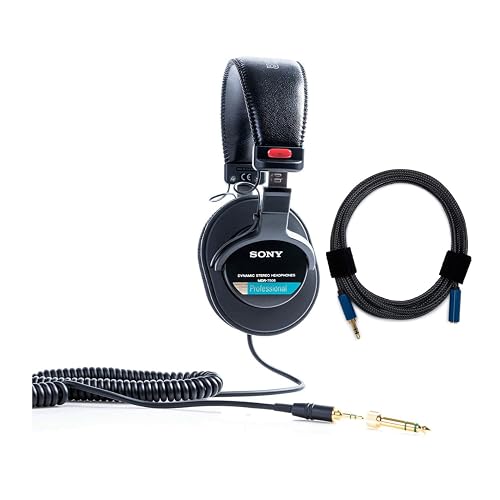 Best for travel and location workSony MDR7506 Folding Professional Closed Ear HeadphonesView on Amazon
- 5
 Best for detailed critical listeningSony MDR-CD900ST Studio Monitor Stereo HeadphonesView on Amazon
- 6
 Best for a spare or second pairSony MDR-7506 Professional Headphones Level 2View on Amazon
Our Top Picks
Quick Comparison
| Product | Best for | Key feature |
|---|---|---|
| Sony MDR-7506 Professional Large Diaphragm Headphone | Overall studio use | 40mm drivers, 10Hz–20kHz |
| Sony MDR-M1 Professional Reference Closed Monitor Headphones | Tracking booths | Closed-back isolation |
| Sony MDR7506 Folding Professional Closed Ear Headphones | Travel and location work | Folding, braided cable |
| Sony MDR-CD900ST Studio Monitor Stereo Headphones | Critical listening | Detailed, neutral response |
| Sony MDR-MV1 Open Back Reference Monitor Headphones | Open-back mixing | Open-back, detachable cables |
| Sony MDR-7506 Professional Headphones Level 2 | Spare or second pair | Proven studio layout |
Sony MDR-7506 Professional Large Diaphragm Headphone
SonyMDR-7506, 40mm drivers, 10Hz-20kHz MDR7506 Professional Large Diaphragm Headphone
Best for: Overall studio use
This is a common first choice for home studios and podcast setups, and it suits anyone who wants a dependable all-round reference.
Pros
- Large 40mm drivers with a wide 10Hz–20kHz range
- Long-standing reputation across studios
Cons
- Bright upper mids can fatigue some listeners
Sony MDR-M1 Professional Reference Closed Monitor Headphones
Sony MDR-M1 Professional Reference Closed Monitor Headphones
Best for: Tracking booths
Closed-back isolation keeps headphone bleed out of vocal and instrument microphones, which suits recording sessions.
Pros
- Sealed design limits sound leakage
- Reference-oriented tuning for monitoring
Cons
- Closed cups can feel warm on long sessions
Sony MDR7506 Folding Professional Closed Ear Headphones
Sony MDR7506 Folding Professional Closed Ear Headphones W/Nylon Braided Cable –
Best for: Travel and location work
The folding frame and braided cable suit people who move gear between sessions, shoots or a laptop bag.
Pros
- Folds flat for transport
- Braided cable resists everyday wear
Cons
- Pads may need replacing after heavy use
Sony MDR-CD900ST Studio Monitor Stereo Headphones
Sony MDR-CD900ST Studio Monitor Stereo Headphones (Japan Import)
Best for: Critical listening
Listeners who want to hear fine detail in a mix often look at this model, which is especially common among engineers in Japan and collectors.
Pros
- Detailed, neutral-leaning presentation
- Durable build for studio use
Cons
- This is a Japan import listing, so check the warranty and plug type
Sony MDR-MV1 Open Back Reference Monitor Headphones
SonyDetachable cables MDR-MV1 Open Back Reference Monitor Headphones
Best for: Open-back mixing
Open-back designs give a wider soundstage, which many mixing engineers prefer in a quiet room.
Pros
- Open-back design for a natural stereo image
- Detachable cables simplify replacement
Cons
- Leaks sound, so it is unsuitable for recording
Sony MDR-7506 Professional Headphones Level 2
Sony MDR-7506 Professional Headphones Level 2 190839079527
Best for: Spare or second pair
Owners who already use the 7506 layout often buy a second pair to keep one in the studio and one at a desk or in a bag.
Pros
- Familiar layout for existing 7506 owners
- Straightforward, no-frills construction
Cons
- Offers no feature changes over the original model
Buying Guide
Open-back versus closed-back
Open-back designs produce a wider, more natural stereo image but leak sound in both directions. Closed-back designs isolate the listener and suit recording rooms.
Impedance and your interface
Higher-impedance models need more power, so check whether your audio interface or headphone amp can drive the pair at full volume.
Related reading
- Will Noise Cancelling Headphones Protect Hearing? Sony vs Bose Compared (2026)
- Warranty for Sony Headphones: How to Check, Claim and Protect Yours
- Sony for Sports Headphones: 6 Best Picks for Workouts (2026)
- Sony Wireless Headphones Pairing: A Step-by-Step Guide for Beginners
- Sony Wired Noise Cancelling Headphones: How to Choose the Right Pair
- Sony Wh-1000xm4 / Xm5 Headphones (2026): Which Should You Choose?
About Owen Palmer
Owen Palmer is part of our editorial team and reviews and edits our brand headphones & noise cancelling guides, checking product details against manufacturer specifications and owner feedback.


