Quick answer
Our overall pick is the CRYSOUND CRY2831 for its professional-grade accuracy and wide measurement range. Other picks are best for detailed frequency analysis, long-term data logging, Bluetooth connectivity, or simple home use.
Finding the best sound meter depends on what you need to measure. Are you checking workplace compliance, logging environmental noise over time, or just curious about the volume in your living room? We compared the manufacturer specifications and listed features for 23 sound meters available on Amazon to help you match a device to your task. Our picks are based solely on the data provided in the listings; we did not test any products hands-on.
Quick picks
- Overall Professional Pick: CRYSOUND CRY2831 Class 2 Sound Meter (see on Amazon)
- Best for On-Site Analysis: CRYSOUND CRY2832-2 Pro Analyzer (see on Amazon)
- Best for Long-Term Logging: CRYSOUND CRY2832-2 Lite Data Logger (see on Amazon)
- Best with Bluetooth: Triplett SLM420BT Datalogger (see on Amazon)
- Best Simple Analog Display: Extech 407730 Digital Sound Meter (see on Amazon)
23 Best Sound Meters compared
| # | Product | Best for | Accuracy | Measurement Range | Weighting Modes |
|---|---|---|---|---|---|
| 1 | CRYSOUND CRY2831 Class 2 Sound Meter | Best overall professional sound meter | ±1.5dB | 29-138dB | A, C, Z |
| 2 | CRYSOUND CRY2832-2 Pro Analyzer | Best sound meter for on-site octave analysis | IEC 61672 Class 2 | Not listed | A, C, Z (implied) |
| 3 | CRYSOUND CRY2832-2 Lite Data Logger | Best sound meter for unattended long-term logging | IEC 61672 Class 2 | 24-130 dB(A) | A, C, Z & F, S, I |
| 4 | SOFT DB Integrating-Averaging Meter | Best sound meter for detailed frequency analysis | IEC 61672 Class 2 | 30 dBA to 130 dBZpk | A, C, Z |
| 5 | Extech SL510 Compact Class 2 Meter | Best compact Class 2 sound meter | ±1dB | 35-130dB | A, C |
| 6 | Triplett SLM420BT Datalogger | Best sound meter with Bluetooth connectivity | ±1.4 dB | 30-130dB | A, C |
| 7 | Extech 407732-KIT Meter with Calibrator | Best sound meter kit with calibrator | Not listed | Not listed | Not listed |
| 8 | Fluke 945 Decibelmeter | Best sound meter from a trusted test tool brand | Type 2 | Not listed | A, C |
| 9 | LATNEX SM-130DB Type 2 Meter | Best sound meter with included calibration certificate | ±1.8dB | 35dB 130dB | Not listed |
| 10 | DANOPLUS Rechargeable Data Logger | Best rechargeable sound meter with visual alarm | ±1.5dB | 30-130dB | A, C |
| 11 | FNIRSI FDM-02 Decibel Meter | Best sound meter for real-time trend viewing | ±1.5 dB | 30–130 dB | A, C |
| 12 | Extech 407730 Digital Sound Meter | Best sound meter with a fast analog bar graph | 2dB | 40-130dB | A, C |
| 13 | TopTes TS-501B Sound Meter | Best sound meter with a large backlit screen | Not listed | 30-130dB | A, C |
| 14 | Goldeep SL750A Sound Meter | Best sound meter with SONE loudness unit | ±1.5dB | 30-130dB | A, C |
| 15 | Protmex PT6708 Sound Meter | Best sound meter with anti-slip, rugged design | 1.5dB | 30-130 dB | A, C |
| 16 | DURFICST Sound Meter with Temp/Humidity | Best sound meter that also measures temperature | ±1.5dB | 30-130dB | A, C |
| 17 | POROMETISTO Digital Sound Meter | Best sound meter with windproof sponge | ±1.5dB | 30-130dB | A, C |
| 18 | Neoteck Digital Sound Level Meter | Best sound meter with fast/slow response toggle | ±1.5 dB | 30 to 130 dB | A, C |
| 19 | ZLLJYBLG GL82A Sound Meter | Best sound meter with auto power-saving | Not listed | 30 to 130dB | A, C |
| 20 | Tadeto Digital Sound Level Meter | Best sound meter with 4-digit resolution display | ±2.0 dB | 30dB to 130dB | A, C |
| 21 | RISEPRO HT-80A Sound Meter | Best basic sound meter with essential features | +/-1.5dB | 30 – 130 dB | A |
| 22 | VLIKE LCD Digital Audio Decibel Meter | Best sound meter with night-use backlight | Not listed | 30 dB to 130 dB | A, C |
| 23 | Soonkoda Digital Sound Level Meter | Best simple A-weighted sound meter | ±1.5dB | 30~130dB | A |
How we chose
We compared manufacturer listings and specifications on Amazon as of October 2026. We did not test, use, or measure any products. Our selections are based on analyzing the listed features, accuracy standards, measurement ranges, and data capabilities to identify which models serve different user needs.
Professional & Compliance-Grade Meters
These meters meet international Class 2 standards and are built for detailed noise investigation.
1. Best overall professional sound meter: CRYSOUND CRY2831 Class 2 Sound Meter

Pros
- Meets IEC 61672-1:2013 Class 2 standards
- Wide 29-138 dB measurement range
- Includes A, C, and Z frequency weighting
Cons
- The listing does not mention wireless connectivity or data logging.
The CRYSOUND CRY2831 is a professional-grade sound level meter meeting IEC 61672-1:2013 Class 2 standards. It features a wide measurement range from 29 to 138 dB and an extended frequency response up to 12.5 kHz. It offers A, C, and Z frequency weighting and includes a factory calibration certificate.
Best for: Professionals who need a calibrated, wide-range meter for industrial or environmental noise measurement.
2. Best sound meter for on-site octave analysis: CRYSOUND CRY2832-2 Pro Analyzer

Pros
- Built-in octave band analyzer
- Data logging and audio recording
- PC software for advanced analysis
Cons
- The listing does not mention battery life.
The CRYSOUND CRY2832-2 Pro is a Class 2 sound level meter with built-in 1/1 and 1/3 octave band analysis. It features data logging, audio recording, and USB/RS232 output for PC software analysis. It has a 3.5-inch color display for reviewing measurements in the field.
Best for: Acoustic consultants and engineers who need to identify and document noise sources with frequency analysis on the spot.
3. Best sound meter for unattended long-term logging: CRYSOUND CRY2832-2 Lite Data Logger

Pros
- Continuous data logging to microSD
- Multiple simultaneous measurements (Leq, Lmax, etc.)
- Programmable trigger and auto modes
Cons
- MicroSD card and card reader are not included.
- Files cannot be read directly via USB from the meter.
The CRYSOUND CRY2832-2 Lite is a Class 2 data logging sound level meter. It measures Leq, Lmax, Lmin, and Lpeak simultaneously with A, C, and Z weighting from 24 to 130 dB(A). It saves data as CSV files to a microSD card and features auto, trigger, and delay measurement modes.
Best for: EHS and facility teams needing to record noise levels over hours or days for later review.
4. Best sound meter for detailed frequency analysis: SOFT DB Integrating-Averaging Meter

Pros
- Simultaneous recording of multiple parameters
- Octave band and FFT analysis
- Includes noise analysis software
Cons
- The listing does not mention the physical size or display type.
This SOFT DB meter is a professional integrating-averaging Class 2 sound level meter with a 30 dBA to 130 dBZpk range. It simultaneously records Leq, Lmax, Lmin, Lpeak, and SEL in A, C, and Z weightings and offers octave band and FFT analysis via included software.
Best for: Advanced users and acousticians requiring detailed frequency analysis and comprehensive data recording.
5. Best compact Class 2 sound meter: Extech SL510 Compact Class 2 Meter

Pros
- ±1 dB Class 2 accuracy
- Backlit LCD display
- Compact and portable
Cons
- The listing does not mention data logging capabilities.
The Extech SL510 is a compact, Class 2 sound level meter with a measuring range of 35 to 130 dB and ±1 dB accuracy. It features a backlit LCD, fast or slow response time, and data hold and min/max functions. It uses A and C weighting.
Best for: Professionals who need a highly accurate, portable meter for spot checks in various lighting conditions.
6. Best sound meter with Bluetooth connectivity: Triplett SLM420BT Datalogger

Pros
- Bluetooth and USB connectivity
- Stores over 32,000 readings
- Analog AC/DC outputs
Cons
- The listing does not mention if analysis software is included.
The Triplett SLM420BT is a professional-grade sound level meter and datalogger that conforms to IEC 61672-1 Class 2. It measures from 30 to 130 dB, stores over 32,000 readings, and features Bluetooth support for iOS/Android apps and a USB interface for PC data transfer.
Best for: Users who want to wirelessly transfer data to a smartphone or PC for monitoring and reporting.
7. Best sound meter kit with calibrator: Extech 407732-KIT Meter with Calibrator
Pros
- Includes 94 dB acoustic calibrator
- Datalogs 16,000 readings
- Displays humidity and temperature
Cons
- The listing does not mention the meter's measurement range or accuracy.
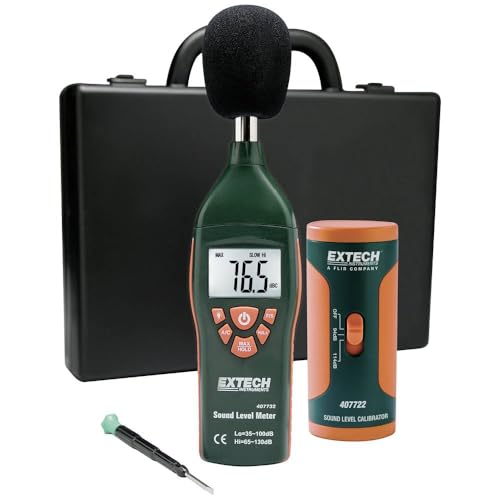
The Extech 407732-KIT is a sound level meter kit that includes a 94 dB calibrator. The meter datalogs up to 16,000 readings, has a USB interface, and features a triple LCD that displays humidity, temperature, and date. It meets Type 2 ANSI/IEC standards.
Best for: Professionals who require a calibrated meter and need to log environmental data alongside sound levels.
8. Best sound meter from a trusted test tool brand: Fluke 945 Decibelmeter

Pros
- From a major test equipment brand
- Meets IEC/ANSI Type 2 standards
- Includes batteries
Cons
- The listing does not mention the measurement range, data logging, or connectivity.
The Fluke 945 is a decibelmeter compliant with IEC651 Type 2 and ANSI S1.4 Type 2 standards. It features A and C weighting, auto range, auto power off, and a backlit display. Batteries are included.
Best for: Technicians and professionals familiar with the Fluke brand who need a reliable, standard-compliant meter.
9. Best sound meter with included calibration certificate: LATNEX SM-130DB Type 2 Meter
Pros
- Includes calibration certificate
- Meets EN 61672 type 2 standard
- 0.1dB resolution
Cons
- The listing does not mention data logging, weighting modes, or connectivity.
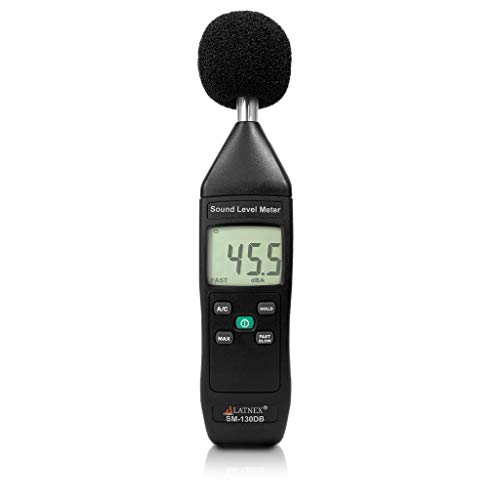
The LATNEX SM-130DB is a Type 2 digital sound level meter that comes with a calibration certificate. It measures from 35dB to 130dB with ±1.8dB accuracy and uses a 1/2 inch electret condenser microphone.
Best for: Applications like workplace monitoring where documented calibration is important for credibility.
Data Logging & Advanced Features
Meters that record noise over time and offer connectivity for deeper analysis.
10. Best rechargeable sound meter with visual alarm: DANOPLUS Rechargeable Data Logger

Pros
- Stores 43,000 data points
- Three-color visual alarm
- Rechargeable battery
Cons
- The listing does not mention compliance with professional standards like IEC 61672.
The DANOPLUS decibel meter is a rechargeable data logger that can store up to 43,000 readings for export to a PC. It features a three-color light alarm for different noise levels, a colored screen with a line chart, and A/C weighting with fast/slow response.
Best for: Continuous monitoring where a visual alarm for threshold levels and extensive data recording are needed.
11. Best sound meter for real-time trend viewing: FNIRSI FDM-02 Decibel Meter

Pros
- Real-time curve display shows trends
- Sets noise thresholds with alarms
- Rechargeable 1500mAh battery
Cons
- The listing does not mention data export or professional standards compliance.
The FNIRSI FDM-02 sound meter has a 2-inch IPS screen that shows a real-time curve of sound changes over 30 seconds. It measures 30–130 dB with A/C weighting, features fast/slow response, and can set high/low noise thresholds with an alarm history.
Best for: Home users and hobbyists who want to see noise trends over time, useful for tuning audio systems.
Home & General Use Meters
Portable, user-friendly sound level meters suitable for checking noise in everyday environments.
12. Best sound meter with a fast analog bar graph: Extech 407730 Digital Sound Meter

Pros
- Fast analog bar graph display
- Max/Min recording
- Includes windscreen
Cons
- The measurement range starts at 40 dB, not suitable for very quiet environments.
The Extech 407730 digital sound level meter measures from 40 to 130 dB with 2 dB accuracy. It features a fast-responding analog bar graph, records max/min values, and includes A and C frequency weighting. It comes with a windscreen and has an auto power-off function.
Best for: Quick, visual checks of noise levels where seeing rapid changes is helpful.
13. Best sound meter with a large backlit screen: TopTes TS-501B Sound Meter

Pros
- Large 2.25-inch backlit screen
- Max/Min and data hold functions
- Includes batteries
Cons
- The listing does not mention data logging or accuracy specification.
The TopTes TS-501B sound level meter has a 2.25-inch backlit LCD screen and measures noise from 30 to 130 dB with A and C weighting. It features max/min measurement, a data hold function, and comes with batteries.
Best for: Home users who want a clear, easy-to-read display for checking noise levels day or night.
14. Best sound meter with SONE loudness unit: Goldeep SL750A Sound Meter

Pros
- Displays dB and SONE units
- ±1.5 dB accuracy
- Fast/slow response modes
Cons
- The listing does not mention data logging or connectivity.
The Goldeep SL750A decibel meter measures from 30 to 130 dB with ±1.5 dB accuracy. It features A/C weighting, fast/slow response, and can display readings in both dB and SONE units for perceived loudness. It tracks max/min values.
Best for: Users interested in understanding both sound intensity (dB) and perceived loudness (SONE).
15. Best sound meter with anti-slip, rugged design: Protmex PT6708 Sound Meter

Pros
- Anti-slip, rugged design
- Fast and slow measurement modes
- Large LCD screen
Cons
- The listing does not mention data logging or connectivity.
The Protmex PT6708 digital decibel reader measures from 30 to 130 dB with 1.5 dB accuracy. It features a large LCD screen, fast and slow measurement modes, A/C weighting selection, and is built with an anti-slip, anti-drop composite material design.
Best for: General use in environments where a durable, easy-to-grip meter is preferred.
16. Best sound meter that also measures temperature: DURFICST Sound Meter with Temp/Humidity

Pros
- Measures temperature and humidity
- Displays dB and SONE units
- ±1.5 dB accuracy
Cons
- The listing does not mention data logging or professional standards.
The DURFICST sound level meter measures noise from 30-130 dB and also displays temperature and humidity. It features A/C weighting, dB/SONE units, and fast/slow response modes with a condenser microphone.
Best for: Users who want to monitor basic environmental conditions alongside sound levels.
17. Best sound meter with windproof sponge: POROMETISTO Digital Sound Meter

Pros
- Includes windproof sponge
- 0.1 dB resolution
- Backlit LCD and auto power-off
Cons
- The listing does not mention data logging or connectivity.
The POROMETISTO digital sound level meter measures 30-130 dB with ±1.5 dB accuracy and 0.1 dB resolution. It includes A/C weighting, fast/slow response, max/min, data hold, and comes with a windproof sponge ball for outdoor use.
Best for: Outdoor noise measurement where wind interference needs to be minimized.
18. Best sound meter with fast/slow response toggle: Neoteck Digital Sound Level Meter

Pros
- Selectable fast/slow response
- Max/Min tracking and data hold
- Backlit LCD display
Cons
- The listing does not mention data logging or connectivity.
The Neoteck decibel meter measures 30 to 130 dB with ±1.5 dB accuracy and a 4-digit LCD display. It features A/C weighting, selectable fast and slow response rates, max/min tracking, data hold, and a backlight.
Best for: General home and office use where adjusting the response speed for different noise types is useful.
19. Best sound meter with auto power-saving: ZLLJYBLG GL82A Sound Meter

Pros
- Auto power-off conserves battery
- Max/Min and data hold functions
- A/C weighting
Cons
- The listing does not mention data logging or accuracy specification.
The ZLLJYBLG GL82A sound level meter measures noise from 30 to 130 dB. It features A/C weighting, fast/slow response modes, max/min recording, data hold, and an auto power-off function after about 12 minutes of inactivity.
Best for: Users who want a basic meter that conserves battery life when left on accidentally.
20. Best sound meter with 4-digit resolution display: Tadeto Digital Sound Level Meter
Pros
- 4-digit LCD with 0.1 dB resolution
- Backlit display
- A/C weighting and fast/slow modes
Cons
- ±2.0 dB accuracy is lower than some other models.
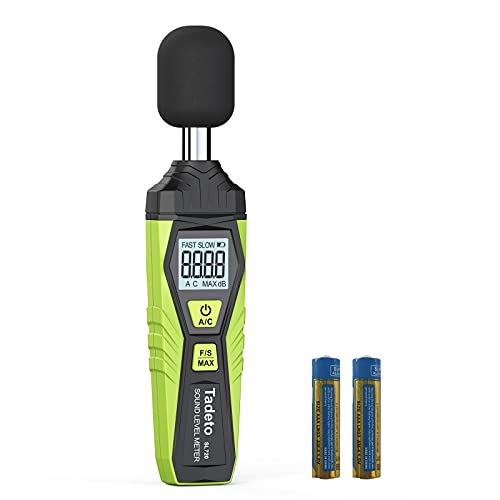
The Tadeto digital sound level meter has a measuring range of 30dB to 130dB with ±2.0 dB accuracy. It features a 4-digit LCD display with 0.1 dB resolution, a backlight, A/C weighted measurement, and fast/slow response modes.
Best for: Users who want a clear numerical readout with high resolution for small level changes.
21. Best basic sound meter with essential features: RISEPRO HT-80A Sound Meter

Pros
- Includes essential functions: hold, max/min, backlight
- +/-1.5dB accuracy
- Auto power off
Cons
- Only lists A weighting, not C weighting.
- The listing does not mention data logging.
The RISEPRO HT-80A digital sound level meter measures from 30 to 130 dB with +/-1.5dB accuracy. It features fast (125ms) time weighting, A frequency weighting, and includes data hold, max/min recording, auto power off, and a backlight.
Best for: A straightforward, no-frills meter for basic home and personal noise checks.
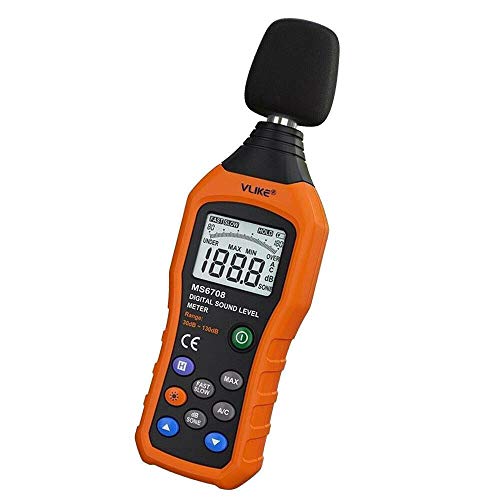
22. Best sound meter with night-use backlight: VLIKE LCD Digital Audio Decibel Meter
Pros
- Backlight for night use
- Auto power-off
- A and C weighting modes
Cons
- Batteries are not included.
- The listing does not mention data logging or accuracy.
The VLIKE LCD digital audio decibel meter measures from 30 dB to 130 dB. It features a backlight for use at night, auto power-off, and is designed for power saving. It uses A and C weighting modes.
Best for: Taking sound readings in low-light or nighttime conditions.
23. Best simple A-weighted sound meter: Soonkoda Digital Sound Level Meter

Pros
- ±1.5dB accuracy
- 0.1dB resolution
- Fast/slow mode selection
Cons
- Only lists A-weighting, not C-weighting.
- The listing does not mention data logging or a display backlight.
The Soonkoda noise meter measures from 30~130dB with ±1.5dB accuracy and 0.1dB display resolution. It uses A-weighted measurement and allows selection between fast and slow response modes.
Best for: Simple, everyday noise measurement focused on environmental (A-weighted) sound levels.
How to choose a sound meter
Selecting the best sound meter starts with understanding your primary goal. Is it for official noise compliance at work, long-term environmental monitoring, or checking if your home theater is too loud for the neighbors? The key specs in the listings will point you in the right direction.
First, consider the measurement range and accuracy. Professional applications often require meters that meet specific standards like IEC 61672 Class 1 or 2, which guarantee a certain level of accuracy across a defined range. For home use, a wider range (e.g., starting at 30 dB) lets you measure very quiet rooms, while a higher top end (130 dB or more) is needed for loud machinery or events. Learn more about how decibels work in our guide to headphone sensitivity.
What to look for
- Standards Compliance: Look for “IEC 61672 Class 2” or “ANSI Type 2” if you need measurements for workplace safety (OSHA) or official reports.
- Weighting Modes: A-weighting (dBA) mimics human hearing for environmental noise. C-weighting (dBC) is for measuring peak, industrial sounds. Some meters offer both.
- Data Capabilities: Do you need a spot reading or a log over time? “Data logging” meters save readings internally or to a memory card. Some connect via USB or Bluetooth to software.
- Frequency Analysis: For troubleshooting noise sources, features like “octave band analysis” or “FFT” break down which frequencies are present.
Finally, think about usability. A backlit screen is essential for low-light conditions, while a simple analog bar graph can make fluctuating levels easier to track visually. For outdoor use, a windscreen or “windproof sponge” is crucial. Always follow the manufacturer’s manual for proper use and safety.
FAQ
What’s the difference between dBA and dBC?
dBA and dBC are different “weightings” applied to the raw sound measurement. A-weighting (dBA) reduces the importance of very low and very high frequencies to approximate how the human ear hears at normal conversation levels. It’s used for environmental noise, workplace safety, and most general purposes. C-weighting (dBC) applies less reduction, giving a better representation of the total sound pressure, which is important for measuring peak levels from machinery, explosions, or loud music. Many meters offer both modes.
Do I need a calibrated sound meter?
If you are taking measurements for legal, regulatory, or official compliance purposes (like OSHA workplace noise assessments), you typically need a meter that meets a recognized standard (like IEC 61672 Class 2) and comes with a valid calibration certificate. For personal, educational, or non-critical home use, a non-calibrated meter may be sufficient to give you a good estimate of noise levels.
Can I use a smartphone app as a sound meter?
While smartphone apps can measure sound, their accuracy is limited by the phone’s built-in microphone, which is not designed for precision measurement. They are not calibrated to international standards. For casual curiosity, an app might be okay, but for any serious purpose—especially regarding hearing safety, legal evidence, or product testing—a dedicated sound level meter is the appropriate tool. For more on protecting your hearing, see the NIDCD.
What does “Fast” and “Slow” response mean on a sound meter?
These are time weighting settings. “Fast” response (usually 125 milliseconds) allows the meter to react quickly to sudden changes in noise, useful for measuring impulsive sounds like hammering or car horns. “Slow” response (usually 1 second) averages the sound level over a longer period, providing a more stable reading for steady-state noise like the hum of an air conditioner or background traffic. Many meters let you switch between them.
References
- Amazon product listings and manufacturer specifications (accessed October 2026)
- World Health Organization. (n.d.). Deafness and hearing loss. Retrieved from https://www.who.int/news-room/fact-sheets/detail/deafness-and-hearing-loss
- National Institute on Deafness and Other Communication Disorders. (n.d.). Noise-Induced Hearing Loss. Retrieved from https://www.nidcd.nih.gov/health/noise-induced-hearing-loss