Quick answer
Our overall pick is the beyerdynamic DT 990 Pro X, an open-back model whose listing describes a 48-ohm drive and reference sound for mixing. Closed-back models such as the Audio-Technica ATH-M50X suit tracking and recording, while the portable, DJ and home-recording picks fit other setups.
Choosing the best studio headphones gets confusing fast, because every listing uses different terms for drivers, impedance and cables. This roundup compares 24 models using their Amazon listings and manufacturer specifications, so you can see what each one actually states about design, connection, cable and weight.
Quick picks
- Open-back mixing reference: beyerdynamic DT 990 Pro X (see on Amazon)
- Closed-back all-rounder: Audio-Technica ATH-M50X (see on Amazon)
- Collapsible for travel: Shure SRH440A (see on Amazon)
- Zero-latency home recording: beyerdynamic DT 270 Pro (see on Amazon)
24 Best Studio Headphones for Mixing and Monitoring compared
| # | Product | Best for | Color | Weight | Cable |
|---|---|---|---|---|---|
| 1 | beyerdynamic DT 990 Pro X | Best overall open-back mixing pick | Grey | 0.64 lb | Detachable cable |
| 2 | beyerdynamic DT 900 PRO X | Best open-back for the final mix | Space Grey | 0.76 lb | Detachable cable |
| 3 | Sennheiser HD 490 PRO | Best washable-pad open-back reference | Black | 0.44 lb | 1.8 m cable |
| 4 | AKG K240 STUDIO | Best semi-open with Varimotion drivers | Gold | 0.53 lb | 3 m (9.9 ft) cable |
| 5 | Audio-Technica ATH-M50X | Closed-back all-rounder for studio work | Black | 0.64 lb | Detachable cable |
| 6 | beyerdynamic DT 770 Pro 80 Ohm | Best 80-ohm pick for universal studio use | Black | 0.59 lb | Wired (cable details not listed) |
| 7 | beyerdynamic DT 700 PRO X | Best with two included mini-XLR cables | Black with Grey | 0.77 lb | Two detachable mini-XLR cables (1.8 m and 3 m) |
| 8 | Audio-Technica ATH-M40x | Best flat-tuned monitor with swivel cups | Black | 0.53 lb | Detachable cables included |
| 9 | Sennheiser HD 280 PRO | Best for strong outside-noise isolation | Black | Not listed | Coiled cable, 3.3 to 9.8 ft |
| 10 | Sony MDR-M1 | Best for the widest stated frequency range | Black | 0.48 lb | Not listed |
| 11 | PreSonus HD5 | Best 50 mm drivers for powerful bass | Black | 0.90 lb | Not listed |
| 12 | Superlux HD660PRO 150-ohm | Best 150-ohm option for interfaces | Black | 1.30 lb | 8.2 ft cable |
| 13 | Shure SRH440A | Best collapsible closed-back for travel | Black | 0.56 lb | Not listed |
| 14 | Tascam TH-MX2 | Best lightweight pick with a carrying bag | Black | 0.66 lb | Not listed |
| 15 | Tascam TH-02 | Best foldable closed-back with rich bass | Black | 0.66 lb | Not listed |
| 16 | OneOdio A71D | Best foldable pick with a 2.2 m cable | Black | Not listed | 2.2 m (7.2 ft) cable |
| 17 | beyerdynamic DT 270 Pro | Zero-latency home recording pick | Black | 0.43 lb | 3 m cable |
| 18 | FIFINE HD8 | Best with two detachable DJ-style cables | Black | 0.58 lb | Two detachable 9.8 ft coiled cables |
| 19 | JOYO JMH-02 | Best flat-response closed-back with 3 m cable | Gray | 0.66 lb | 3 m straight cable |
| 20 | Audio-Technica ATH-M30x | Best for mid-range detail and field recording | Black | 0.49 lb | Not listed |
| 21 | Audio-Technica ATH-M20x | Best for enhanced low-frequency tuning | Black | 0.46 lb | Not listed |
| 22 | M-Audio HDH40 | Best rotating frame with leather cushions | Black | 0.62 lb | 2.7 m fixed cable |
| 23 | OHAYO M20 | Best for sharing with a second headphone | Black | 0.80 lb | 3 m retractable cable |
| 24 | OneOdio A71 | Best single-sided monitoring for DJs | Black | 0.83 lb | Coiled cord, 6.6 to 9.8 ft |
How we chose
We compared manufacturer listings and specifications on Amazon as of November 2026. We did not test any of these headphones hands-on. Every fact here comes from the listing data, and where a figure looked implausible or conflicted with the title or features, we left it out. Our headphone buying guides explain the terms in this article.
Criteria included design (open-back, closed-back or semi-open), listed drivers and frequency response, stated impedance and connection options, cable details, listed weight and color, and the use cases each listing describes. Each product also received its own label so no two picks read the same.
Open-back and semi-open for mixing
These models suit mixing and critical listening, where the listings emphasize open sound over isolation.
1. Best overall open-back mixing pick: beyerdynamic DT 990 Pro X

Pros
- 48-ohm drive, listed as needing no headphone amp
- Open-back soundstage presented for mixing
- Detachable cable
Cons
- Open-back design lets sound leak, so it suits mixing more than tracking
- The listing does not mention a frequency range
The listing describes an open-back design with a 48-ohm drive, so it can be driven from a laptop, audio interface, phone or console without a headphone amp. The STELLAR.45 driver and open-back soundstage are presented for mixing, editing and critical listening. It comes in grey with velour pads and a detachable cable, and weighs about 0.64 lb.
Best for: Mixers who want open-back reference sound and a drive that works from most sources.
2. Best open-back for the final mix: beyerdynamic DT 900 PRO X

Pros
- Open-back reference sound presented for final mixes
- STELLAR.45 driver
- 48-ohm drive listed
Cons
- Open-back design, so it is less suited to tracking where bleed matters
- The listing does not mention a frequency range
This open-back model uses the STELLAR.45 driver and a 48-ohm drive. The listing presents it as built for the final mix, mastering and critical listening, with wide, natural imaging that shows where each element sits. It is listed in space grey with a detachable cable and weighs about 0.76 lb.
Best for: Engineers focused on final mixes who want an open-back reference with a detachable cable.
3. Best washable-pad open-back reference: Sennheiser HD 490 PRO

Pros
- Uncolored frequency response, 5 to 36,000 Hz
- Washable, replaceable ear pads
- 1.8 m cable included
Cons
- Open-back design, so sound leaks and it suits mixing more than tracking
- The listing does not mention a detachable cable
This open-back reference model is described with an extremely wide, dimensional soundstage and ultra-precise localization. The listing gives an uncolored frequency response from 5 to 36,000 Hz and a low-frequency cylinder system. Its pads are washable and replaceable, the 1.8 m cable is included, and the packaging is listed as FSC-certified. The black build weighs about 0.44 lb.
Best for: Mixing users who want an open-back reference with replaceable pads and a listed wide frequency response.
4. Best semi-open with Varimotion drivers: AKG K240 STUDIO

Pros
- Varimotion diaphragms, as listed
- Screw-on 1/4-inch adapter included
- Self-adjusting headband
Cons
- The title mentions an XLR connector, while the features list a 1/8-inch plug, so confirm before buying
This semi-open model uses 30 mm XXL transducers with patented Varimotion diaphragms, and the listing gives an impedance of 55 ohms. It includes a stereo 1/8-inch connector, a screw-on 1/4-inch adapter and a 3 m (9.9 ft) cable. The self-adjusting headband and over-ear pads are described for long studio sessions, and the finish is gold.
Best for: Mixing and mastering users who want a semi-open sound and a ready-to-use 1/4-inch adapter.
Closed-back for studio tracking
These closed-back models are described for recording and monitoring, with isolation that limits sound leakage.
5. Closed-back all-rounder for studio work: Audio-Technica ATH-M50X

Pros
- 45 mm drivers with copper clad aluminum voice coils
- Circumaural design for sound isolation
- Detachable cable
Cons
- The listing does not state an impedance figure
This Audio-Technica model uses 45 mm large-aperture drivers with rare earth magnets and copper clad aluminum wire voice coils. The listing describes an extended frequency range, deep and accurate bass, and a circumaural design that isolates sound in loud rooms. A detachable cable is included, and the black build weighs about 0.64 lb.
Best for: Home studio users who want one closed-back headphone for tracking, mixing and listening.
6. Best 80-ohm pick for universal studio use: beyerdynamic DT 770 Pro 80 Ohm

Pros
- 80-ohm option described for universal studio use
- Closed-back design limits sound leakage
- Black velour ear pads for long sessions
Cons
- The listing does not state a cable type
- Pick the impedance that fits your gear, since the line offers other values
The 80-ohm version is one of three impedance options in this line. The listing describes 32 ohm for mobile gear, 80 ohm for general studio use, and 250 ohm for high-powered setups. The closed-back construction is described as minimizing sound leakage, and the black velour ear pads are presented for long sessions. A limited edition velour pad set is named in the title.
Best for: Studio users whose gear matches the 80-ohm option and who want closed-back isolation for recording.
7. Best with two included mini-XLR cables: beyerdynamic DT 700 PRO X

Pros
- 48-ohm drive for direct connection
- Two detachable mini-XLR cables included
- Closed-back isolation for tracking
Cons
- Uses mini-XLR cables, so confirm your gear has a matching input
- Weighs about 0.77 lb, heavier than several models here
This closed-back model pairs a 48-ohm drive with the STELLAR.45 driver, and the listing says it connects straight to interfaces, laptops, phones or consoles. It is aimed at tracking vocals and instruments, with isolation described as preventing bleed. Two detachable mini-XLR cables, 1.8 m and 3 m, are included for switching between a desk and a studio.
Best for: Recording musicians who want closed-back tracking and two cable lengths in the box.
8. Best flat-tuned monitor with swivel cups: Audio-Technica ATH-M40x

Pros
- Tuned flat, according to the listing
- 90-degree swiveling earcups
- Detachable cables included
Cons
- The listing does not state an impedance or frequency range
The M40x pairs 40 mm drivers with rare earth magnets and copper-clad aluminum wire voice coils. The listing says it is tuned flat for accurate monitoring across the frequency range. Its earcups swivel 90 degrees, the earpads and headband are described as pro-grade, and detachable cables are included. A circumaural design is listed for sound isolation in loud spaces.
Best for: Monitoring users who want a flat-tuned, closed-back headphone with flexible earcups.
9. Best for strong outside-noise isolation: Sennheiser HD 280 PRO

Pros
- Up to 32 dB attenuation of outside sound, as listed
- Padded earcups for an around-the-ear fit
- Coiled cable from 3.3 to 9.8 feet
Cons
- Coiled cable only, with no detachable option listed
This closed-back, around-the-ear model has padded earcups and is listed with up to 32 dB attenuation of outside sound. The coiled cable runs from 3.3 to 9.8 feet. The listing describes an extended frequency response and warm, natural reproduction, and it is presented as lightweight with an ergonomic design.
Best for: Users in noisy rooms who want a closed-back headphone for monitoring, recording or fieldwork.
10. Best for the widest stated frequency range: Sony MDR-M1

Pros
- Stated range of 5 Hz to 80 kHz
- Closed acoustic structure for isolation
- Developed with industry engineers, per the listing
Cons
- The listing does not mention a detachable cable or cable length
- The listing does not state impedance
The Sony MDR-M1 is a closed-back reference model whose listing describes an ultra-wideband driver with a stated reproduction range from 5 Hz to 80 kHz. The closed acoustic structure is presented for sound isolation and detailed monitoring across production workflows. The listing says it was developed with industry engineers, and it weighs about 0.48 lb in black.
Best for: Producers who prioritize the widest listed frequency range in a closed-back design.
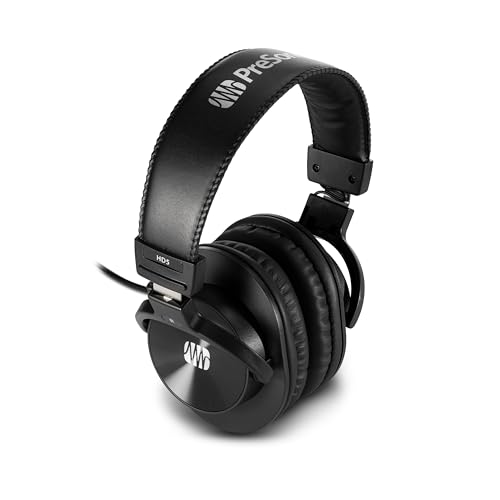
11. Best 50 mm drivers for powerful bass: PreSonus HD5
Pros
- 50 mm neodymium drivers
- Stated 15 Hz to 25 kHz range
- Closed-back over-ear design
Cons
- Heavier listed weight at about 0.90 lb
- The listing does not state cable or impedance details
The PreSonus HD5 is a closed-back, over-ear monitoring headphone with 50 mm neodymium drivers that the listing says deliver clear audio with powerful bass. Its stated frequency range is 15 Hz to 25 kHz. The listing presents extended comfort for recording or private listening, and it is listed in black with a weight of about 0.90 lb.
Best for: Recording users who want larger drivers and a closed-back design for bass-heavy material.
12. Best 150-ohm option for interfaces: Superlux HD660PRO 150-ohm

Pros
- 150-ohm version, as listed
- Velvet ear pads and leather headband
- 3.5 mm plug with 6.3 mm adapter
Cons
- Heaviest listed weight in this set at about 1.30 lb
- The listing does not state whether the cable detaches
The Superlux HD660PRO is a closed-back model in its 150-ohm version, with 40 mm drivers and a listed 10 Hz to 30 kHz response. The listing describes an upgraded leather headband, velvet ear pads and swivel ear cups. It includes a 3.5 mm plug and a 6.3 mm adapter, with an 8.2 ft cable for mixers, guitars and mobile devices.
Best for: Producers using an audio interface who want a 150-ohm closed-back model with velvet pads.
Portable and foldable for travel
These picks emphasize folding, collapsing or carrying features for moving between locations.
13. Best collapsible closed-back for travel: Shure SRH440A

Pros
- Collapsible design for storage and carrying
- Adjustable headband and cushioned earcups
- Closed-back design
Cons
- The listing does not state a frequency range or impedance figure
- Cable details are not listed
The Shure SRH440A is a closed-back model whose listing describes an updated design, a balanced sound signature and extended frequency response for monitoring and mixing. It is presented as lightweight, with an adjustable headband, cushioned earcups and a collapsible frame for storage and carrying. The listed weight is about 0.56 lb.
Best for: Musicians who record away from a fixed studio and need a headphone that packs down.
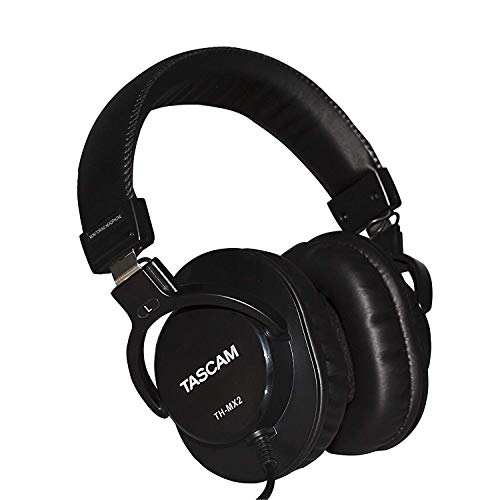
14. Best lightweight pick with a carrying bag: Tascam TH-MX2
Pros
- Closed-back design
- Padded headband and ear bands
- Adapter and leatherette bag included
Cons
- The listing does not state a frequency range or impedance
- The listing does not mention a detachable cable
The Tascam TH-MX2 is a closed-back mixing headphone with a 40 mm neodymium magnet driver. Its headband and ear bands are tightly stitched and padded. The listing includes a screw-on 1/8-inch to 1/4-inch adapter and a leatherette bag. It is listed in black and weighs about 0.66 lb.
Best for: Mixing users who want a closed-back headphone that comes with its own bag and adapter.
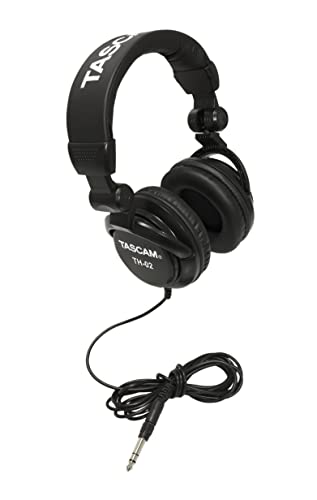
15. Best foldable closed-back with rich bass: Tascam TH-02
Pros
- Foldable for compact transport
- Rich bass and crisp highs, per the listing
- Snap-on adapter included
Cons
- The listing does not state driver size or frequency range
The TH-02 is a foldable, closed-back dynamic headphone that the listing describes for recording, podcasts, DJing, music and guitar. It is presented with clean sound, rich bass response and crisp highs, along with a padded headband and ear pads. A snap-on 1/8-inch to 1/4-inch adapter is included, and the black model weighs about 0.66 lb.
Best for: Users who want a foldable closed-back headphone for several uses, from recording to guitar.
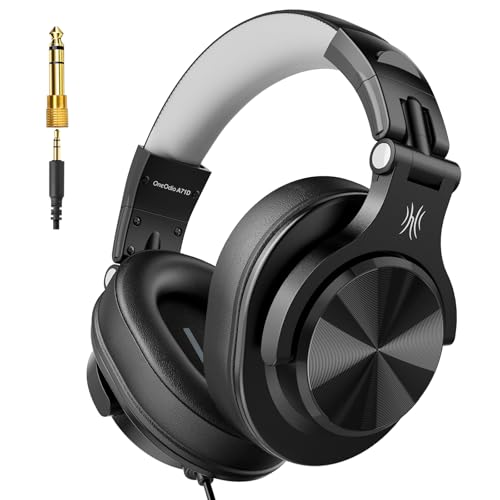
16. Best foldable pick with a 2.2 m cable: OneOdio A71D
Pros
- Foldable design
- 2.2 m (7.2 ft) cable with 3.5/6.35 mm plugs
- 90-degree swiveling earcups
Cons
- The listing does not state a weight
- The listing does not mention a detachable cable
The OneOdio A71D is a foldable wired over-ear headphone with 40 mm drivers that the listing says offer deep bass, clear mids and crisp highs. Its 90-degree swiveling earcups support single-ear monitoring. The listing includes ultra-soft padded ear muffs, an adjustable headband and a 2.2 m (7.2 ft) cable with 3.5/6.35 mm plugs.
Best for: Users who want a foldable DJ-style headphone with a 2.2 m cable and single-ear monitoring.
Home recording and podcast monitoring
These models are presented for home studios, podcasts and voiceover work.
17. Zero-latency home recording pick: beyerdynamic DT 270 Pro

Pros
- Zero-latency monitoring, per the listing
- Closed back keeps click tracks out of the mic
- Soft grey ear pads
Cons
- The listing does not state driver size or frequency range
- The listing does not mention a detachable cable
The DT 270 Pro is a wired closed-back model for home recording and podcasting. The listing describes zero-latency monitoring during recording and says the closed back keeps the click track out of your microphone. Soft grey ear pads and a lightweight fit are presented for long sessions. The black model includes a 3 m cable and weighs about 0.43 lb.
Best for: Home recordists who want wired, zero-latency monitoring with a closed back.
18. Best with two detachable DJ-style cables: FIFINE HD8

Pros
- Two detachable 9.8 ft cables
- Stated 20 Hz to 20 kHz range
- Soft padded ear cushions
Cons
- Coiled cables, which the listing describes as DJ-style
- The listing describes isolation as decent, not strong
The FIFINE HD8 is a closed-back studio headphone with 50 mm drivers, a listed 20 Hz to 20 kHz frequency range and soft padded ear cushions. The listing calls its passive noise canceling a seal-based isolation rather than electronic cancellation. Two 9.8 ft detachable DJ-style coiled cables with 3.5 mm and 1/4-inch plugs are included, and it weighs about 0.58 lb.
Best for: Podcasters and mixers who want two detachable cables with both 3.5 mm and 1/4-inch plugs.
19. Best flat-response closed-back with 3 m cable: JOYO JMH-02

Pros
- Flat response, 20 Hz to 20 kHz, per the listing
- Passive isolation from a closed circumaural design
- Self-adjusting headband
Cons
- The listing mentions a straight 3 m cable and no detachable option
- The listing does not state an impedance
The JOYO JMH-02 is a closed circumaural headphone with 50 mm neodymium drivers and a listed flat response from 20 Hz to 20 kHz. Its passive isolation comes from a seal around the ears. A 3-meter straight cable is included with 3.5 mm and 6.35 mm adapters. The self-adjusting leather-cushion headband and plush earcups are listed in gray, and the weight is about 0.66 lb.
Best for: Home studio users who want a flat-response closed-back with a long straight cable.
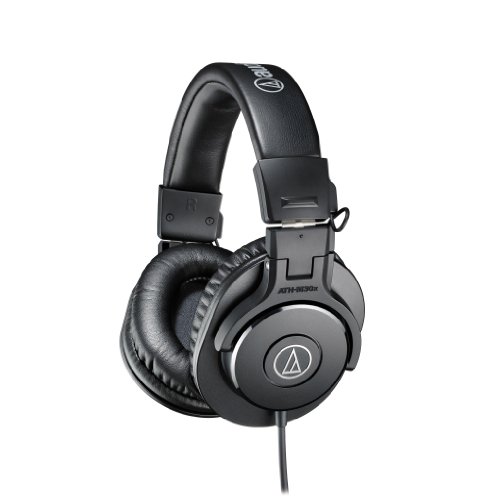
20. Best for mid-range detail and field recording: Audio-Technica ATH-M30x
Pros
- Mid-range definition, per the listing
- Screw-on adapter and carrying pouch
- Closed-back circumaural isolation
Cons
- The listing does not state a frequency range or impedance
The ATH-M30x is a closed-back, circumaural monitor with 40 mm drivers that use rare earth magnets and copper clad aluminum wire voice coils. The listing says it is tuned for enhanced detail with excellent mid-range definition. It includes a screw-on adapter and a carrying pouch, and it is listed for tracking, mixing and field recording at about 0.49 lb.
Best for: Users who record in varied locations and want a closed-back headphone with mid-range detail.
21. Best for enhanced low-frequency tuning: Audio-Technica ATH-M20x

Pros
- 96 dB sensitivity, as listed
- Suspension headband
- Tuned for enhanced low-frequency performance
Cons
- Stated 15 to 20 kHz range is narrower than several others in this roundup
- The listing does not mention a detachable cable
The ATH-M20x is a closed-back monitor with 40 mm drivers, a listed 96 dB sensitivity and a 15 to 20 kHz frequency response. The listing describes tuning for enhanced low-frequency performance and a suspension headband. It includes a 6.3 mm adapter and is presented for monitoring, tracking and mixing. The listed weight is about 0.46 lb.
Best for: Users who want closed-back monitoring with a bass-forward tuning and a suspension headband.
22. Best rotating frame with leather cushions: M-Audio HDH40

Pros
- 180-degree rotatable frame
- Leather cushioning and flexible headband
- 32 ohm and 95 dB sensitivity listed
Cons
- The 2.7 m cable is fixed, not detachable, per the listing
The M-Audio HDH40 uses 40 mm neodymium drivers in a closed-back design. Its frame rotates 180 degrees and has stainless steel telescopic arms, leather cushioning and a flexible headband. The listing gives 32 ohm impedance and 95 dB sensitivity. A 2.7 m fixed cable connects to phones and tablets, and a 1/4-inch adapter reaches mixers and interfaces.
Best for: Podcasters and home recorders who want a rotating frame and a long cable.
DJ and shared monitoring
These models add single-ear monitoring or a way to share audio with a second headphone.
23. Best for sharing with a second headphone: OHAYO M20
Pros
- Share Port for a second wired headphone
- 3 m retractable cable
- 32-ohm impedance listed
Cons
- The listing does not state whether the design is open-back or closed-back
- Heavier listed weight at about 0.80 lb
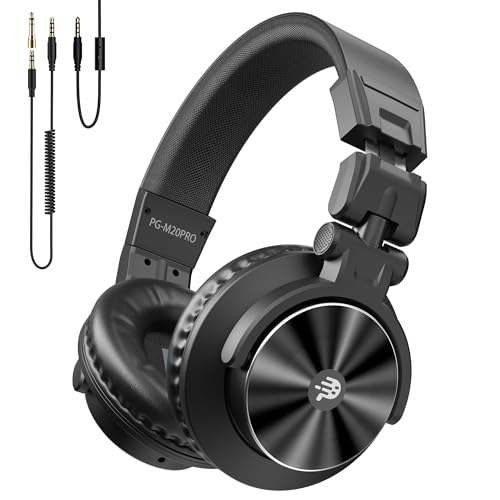
The OHAYO M20 is an over-ear wired headphone with 50 mm dynamic drivers and 32-ohm impedance. Its 3 m retractable cable is described as helping keep excess cable organized. A built-in Share Port lets a second pair of wired headphones connect directly, which the listing suggests for podcast co-hosts and music lessons. It connects to 3.5 mm and 6.35 mm gear.
Best for: Podcast co-hosts, teachers and recording sessions where two people need to hear the same audio.
24. Best single-sided monitoring for DJs: OneOdio A71

Pros
- Single-sided monitoring with 90-degree swivel
- Foldable design, per the title
- 3.5 mm and 6.35 mm plugs included
Cons
- Coiled cord only, with no detachable option listed
- Heavier listed weight at about 0.83 lb
The OneOdio A71 is a wired over-ear model with 40 mm drivers that the listing calls Hi-Res. Its 90-degree swiveling earcups allow single-sided monitoring, leaving one ear free for conversation. The adjustable, stretchable headband and soft padded cushions are listed. A coiled cord of 6.6 to 9.8 ft comes with 3.5 mm and 6.35 mm plugs, and the weight is about 0.83 lb.
Best for: DJs and mixers who need one ear free while monitoring and talking to others.
How to choose the best studio headphones for your room
Start with the job, because the best studio headphones for one task can be the wrong pick for another. Open-back designs let sound pass through the ear cups, so the listings for these models present them for mixing and critical listening. Closed-back designs limit leakage, which is why the tracking models highlight isolation. Semi-open models sit between the two. Our headphone buying guides cover the basics in more detail.
Next, read the impedance and connection details. Some listings state an impedance, such as 32 ohm, 48 ohm, 80 ohm or 150 ohm. Impedance describes how a headphone pairs with the power your gear provides, and the listings in this roundup tie specific values to specific gear. Some listings do not state impedance at all, and it is better to note that gap than to guess.
Cables matter too. Detachable cables make swaps and repairs easier, and some listings include a second cable for a desk or studio setup. Coiled cords suit DJ-style and fixed setups, while fixed cables leave you with one length. Check the plug type before you buy, since listings here mix 1/8-inch, 1/4-inch, 3.5 mm and 6.35 mm connectors, and some use mini-XLR.
Finally, weigh comfort and portability. A heavier listed weight may be fine for a seated session but tiring over a long day, and foldable or collapsible models are easier to carry. Whatever you choose, follow the manufacturer’s manual for safe use and keep volume moderate. The National Institute on Deafness and Other Communication Disorders explains how loud sound can affect hearing.
What to look for
- Open-back for mixing, closed-back for tracking
- A listed impedance that matches your interface, mixer or phone
- Cable type, length and whether it detaches
- Adapters included for your plug type
- Weight and comfort for long sessions
FAQ
Are open-back headphones better for mixing?
The listings for open-back models in this roundup present them for mixing, editing and critical listening, because the open design shapes sound differently from closed models. Closed-back models are the ones presented for tracking. Choose based on the job you do most often, and see our headphone buying guides for more context.
Do I need a headphone amp for these?
Some listings, such as the beyerdynamic 48-ohm models, state that no headphone amp is needed. For others the listing says nothing about amplification, so check your device and the manufacturer’s manual before you connect.
How can I protect my hearing with studio headphones?
Keep volume moderate, take breaks and follow the manufacturer’s manual. The NIDCD explains how noise can affect hearing over time.
Which of the best studio headphones suit podcasting?
Podcasters often look at the closed-back models in our home recording group, such as the beyerdynamic DT 270 Pro, the FIFINE HD8 and the OHAYO M20 if a co-host needs to listen too. Compare cable details and weight before you decide.
References
- Amazon product listings and manufacturer specifications (accessed November 2026)
- National Institute on Deafness and Other Communication Disorders: Noise-Induced Hearing Loss